
Use Alamance County Court Records Search
The main online access point for Alamance County court records is the NC eCourts Portal. Smart Search is used for case information. Search Hearings is used for court dates. NC Judgment Search is used when the key fact is a judgment rather than a full case file. The county Judicial Branch page also links to court-date tools, payments, calendars, local forms, and courthouse information, but the Portal is the broad search route for public case information in eCourts counties.
For a narrow Alamance County court records search, start with a case number when available. If the case number is not known, use a party name and add the Alamance location filter. The official Portal training states that Smart Search can use party name, record or case number, citation number, attorney name, attorney bar number, business name, cross-reference number, or nickname. Common names need extra filters, such as case type, filing date range, party date of birth, or case status.
- Open the NC eCourts Portal and choose Smart Search for case records.
- Enter a case number, citation number, party name, business name, attorney name, or attorney bar number.
- Use Advanced Filtering Options and set the location or county to Alamance when the result set is broad.
- Open the matching case summary and review the case type, parties, filing date, events, hearings, judgments, and public documents if available.
- Use Search Hearings for court dates, NC Judgment Search for judgment index results, or the Clerk of Superior Court for paper files and certified copies.
Alamance County Court Records Fields
Smart Search works best when one strong identifier is paired with a county filter. The Portal also supports wildcard searches. The official training explains that a party-name wildcard needs at least three characters plus an asterisk for a last name and at least one character plus an asterisk for a first name. A case-number wildcard needs at least four characters plus an asterisk. Enterprise Justice case numbers use four parts: a two-digit year, case type letters, a six-digit sequence, and a three-digit county identifier.
| Field Label | Type | Required | Notes / Format |
|---|---|---|---|
| Smart Search | Text | No | Search by party, case number, citation, attorney, business, cross-reference, or nickname. |
| Advanced Filtering Options | Expandable filter | No | Includes general options, party criteria, and case criteria. |
| Location / County | Dropdown or filter | No | Use Alamance to narrow results to local court records. |
| Party name | Text filter | No | Wildcard searches are supported with minimum character rules from Portal training. |
| DOB | Date filter | No | Useful when several people have the same name. |
| Case type | Dropdown or filter | No | Includes Civil Actions, Special Proceedings, Estates, and Criminal Actions. |
| Case status | Dropdown or filter | No | Status filtering exists, though exact public dropdown choices vary by view. |
| Case filing date range | Date range | No | Helps separate older and newer cases with similar parties. |
Types of Alamance County Court Records
Alamance County court records are made in the North Carolina General Court of Justice. The state does not operate separate municipal court systems. City police, deputies, and troopers may issue citations or make arrests, but the court case is handled in District Court or Superior Court. Civil matters are handled at the Alamance County Historical Courthouse, while criminal and traffic matters are handled at the Judge J.B. Allen Jr. Criminal Courthouse.
Public court files can include more than the final judgment. The record may show the first filing, parties, service papers, motions, orders, hearing settings, continuances, disposition, costs, and appeal notices. The exact record depends on the case type. Some matters have public online summaries, while certified copies and complete paper files still point to the clerk.
- Civil Actions: complaints, summonses, answers, motions, orders, judgments, dismissals, appeals, and execution records.
- Criminal Actions: charges, warrants or orders after execution, citations, pleas, judgments, sentencing, costs, fines, and disposition entries.
- Family and domestic records: divorce judgments, custody, support, protective orders, alimony, equitable distribution, and name-change records when public.
- Estates and special proceedings: wills, inventories, administrations, accountings, guardianships, and other files handled by the Clerk of Superior Court as probate judge.
- Traffic and infractions: citations, hearing dates, waivers, fines, costs, failure-to-appear entries, and court dispositions.
The Judicial Branch records help topic is the statewide source for public terminals, paper files, and clerk access when online records do not answer the question.
What Alamance County Court Records Show
A public case view is a summary, not always the whole court file. It can identify the case, show the court division, list parties, mark the filing date, display hearings, and link some documents in eCourts counties. For judgment research, NC Judgment Search may show the case number, disposition status, index date or time, parties to the action, and judgment comments. For criminal records, public terminals and certified criminal record searches may be more useful than a general Portal search.
| Field | What It Shows |
|---|---|
| Case Number | Enterprise Justice case format with year, case type letters, sequence number, and county identifier. |
| Case Type | Civil Actions, Criminal Actions, Estates, Special Proceedings, Family, Small Claims, or judgment items. |
| Parties | Plaintiff and defendant, state and defendant, petitioner and respondent, estate parties, attorneys, or representatives. |
| Filing Date | The date the case or filing was opened in the court record. |
| Hearings | Date, time, location, judicial officer, courtroom, and hearing type when available in Search Hearings. |
| Docket / Events | Filings and actions such as complaint filed, summons issued, motion filed, order entered, judgment, continuance, plea, or notice of appeal. |
| Disposition | The result of a claim, charge, motion, or case, including dismissal, judgment, plea, verdict, or other outcome. |
| Financial Fields | Court costs, fines, restitution, judgment amounts, bond, copy fees, or payment entries when public. |
The Judicial Branch public-records request form is a separate statewide route for existing Judicial Branch public records, and the manifest image below comes from that source: Judicial Branch public-records request form.
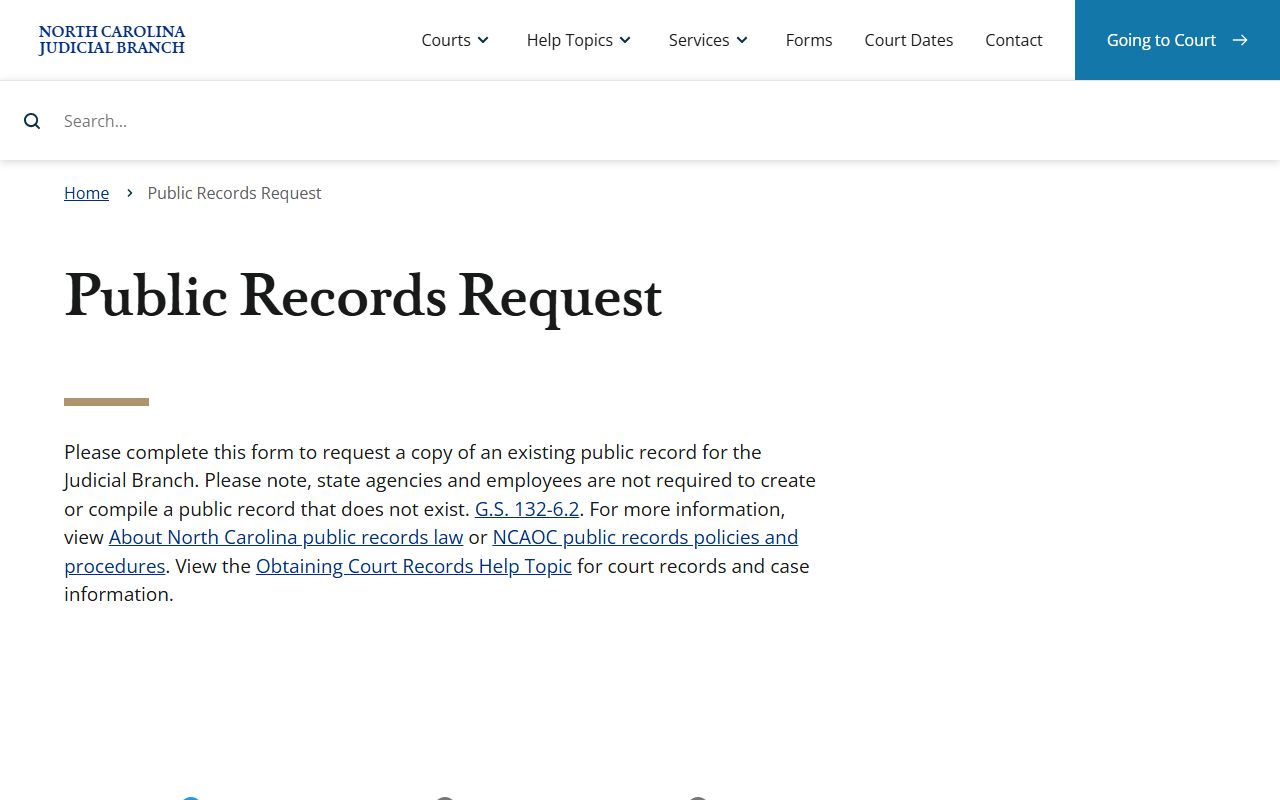
That form is useful for Judicial Branch public records, but the research notes that NCAOC is not the custodian for court documents, case information, or vital certificates.
Alamance County Court Records Access
Every access channel has a different role. Portal search is best for public case summaries. Search Hearings is best for upcoming court dates. NC Judgment Search is best for judgment-index questions. Public self-service terminals in Clerk of Superior Court offices can be used for criminal case information and certified criminal record searches. Paper files are accessed by visiting the clerk in the county where the case is located. Certified copies, older files, restricted access questions, and divorce judgments also point back to the clerk.
Civil files, estates, and special proceedings point first to 1 Court Square in Graham. Criminal and traffic case records point first to 212 West Elm Street. The Sheriff's public-records process is not a shortcut for court documents. The research states that the Sheriff's public-records page routes arrest and search warrant requests to the Alamance County Clerk's Office or NCAOC. Register of Deeds records are also separate from court files; marriage certificates and land records are handled by that office, not the Clerk of Superior Court.
Note: Use the clerk for certified copies, paper files, older cases, and records not visible in public Portal view.
Alamance County Court Records Law
North Carolina court-record access is grounded in court-specific record law. G.S. 7A-109 directs clerks to maintain court records, files, dockets, and indexes, and it makes those records open to public inspection during regular office hours unless another law blocks access. North Carolina's Chapter 132 Public Records Act also governs public records made or received by state and local agencies.
The Judicial Branch request-a-record page is important because it states the limits of a statewide request. NCAOC does not fulfill requests for court documents, case information, birth certificates, marriage certificates, divorce certificates, death certificates, or criminal background checks through that form. Court documents and case information must be found through Portal or requested from the Clerk of Superior Court in the county where the case was filed. Agencies also do not have to create or compile a record that does not exist.
The official request routing page is reflected in this manifest image source: Request a public record.
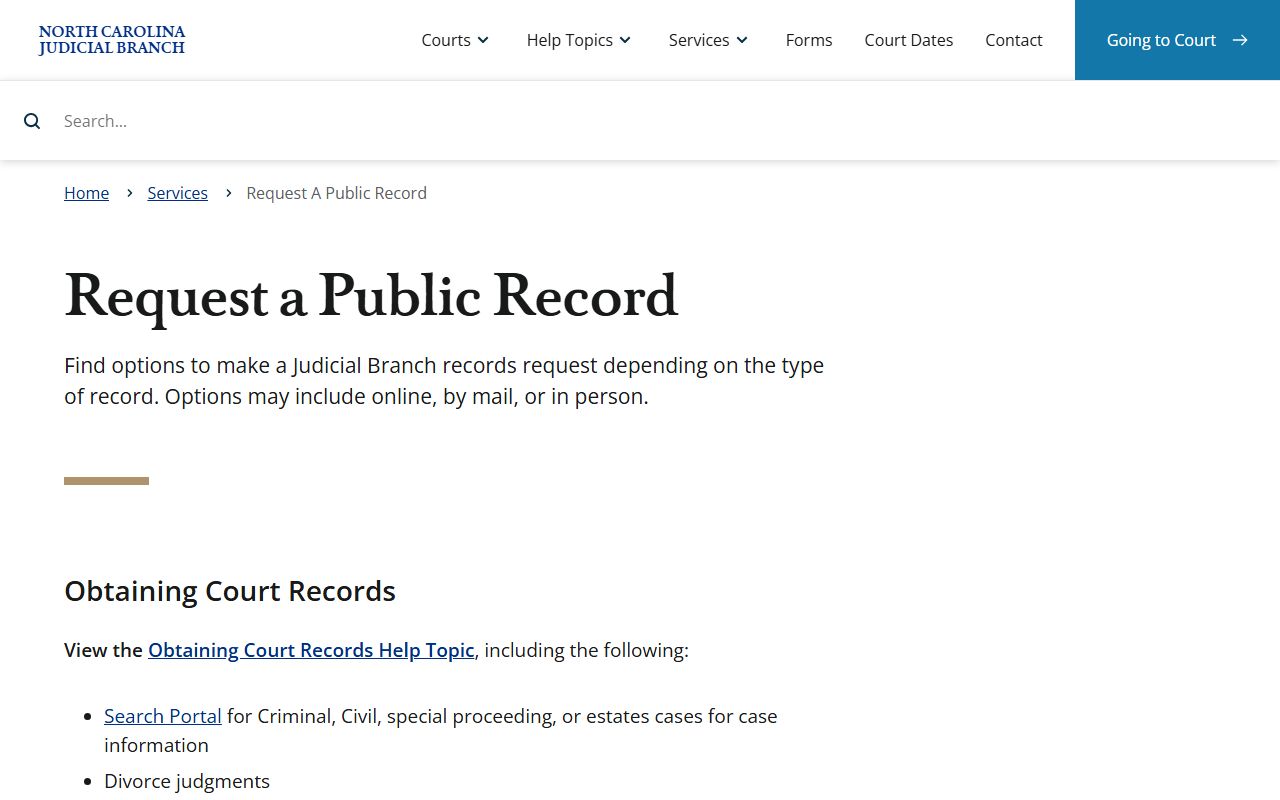
The routing distinction keeps court case files with the clerk and sends non-court agency records to the proper public-records custodian.
Alamance County Court Record Copies
Copies of Alamance County court records may involve regular copy fees, certification fees, or court-cost items depending on the record and request. The research source did not supply a county-specific copy fee table from the Clerk of Superior Court. It did identify the Judicial Branch court-cost pages as the current source for civil, criminal, estates, and special-proceedings costs. Use current court-cost publications for fee checks before filing or requesting large copy sets.
The fee and cost source used for the manifest image is the Judicial Branch court-costs help area: court costs and fees.
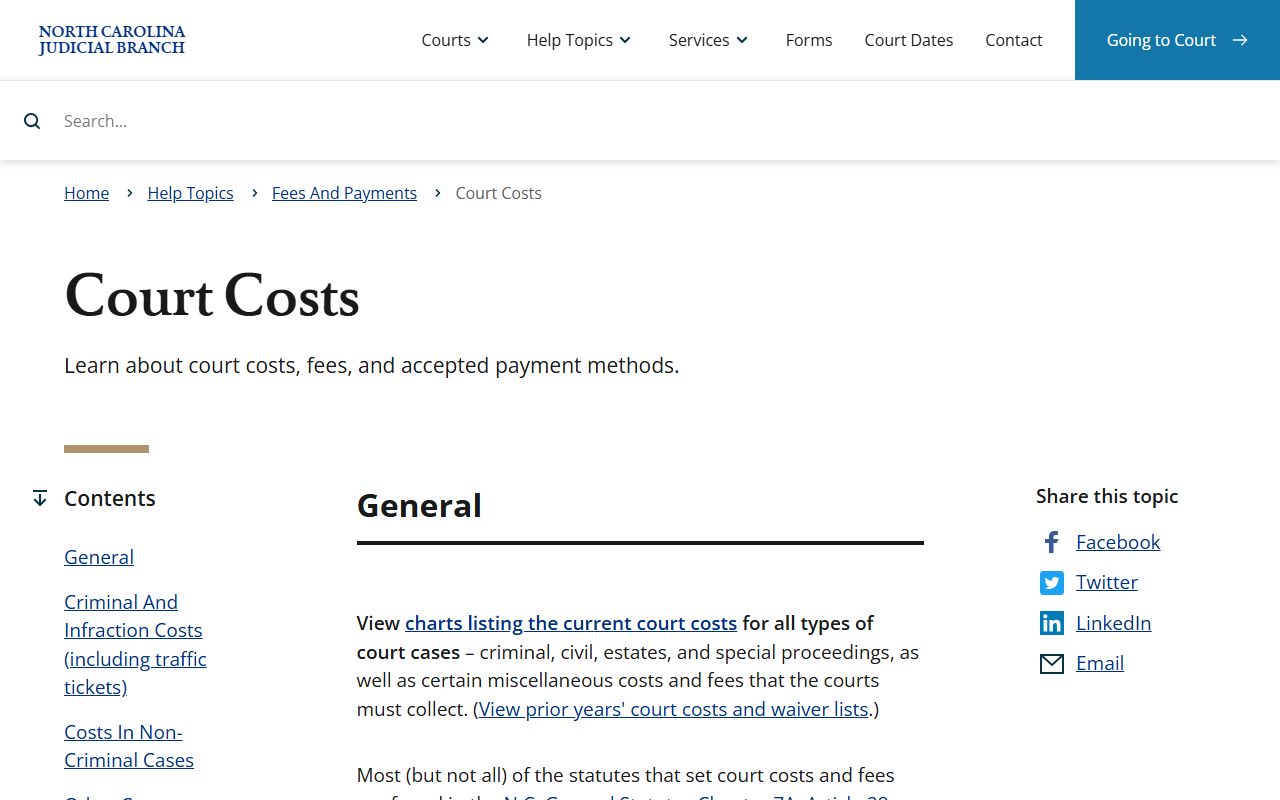
For filings or certified copies, the practical step is to confirm the current amount with the clerk before mailing payment or visiting the counter.
The Judicial Branch also maintains current cost publications here: current court costs.
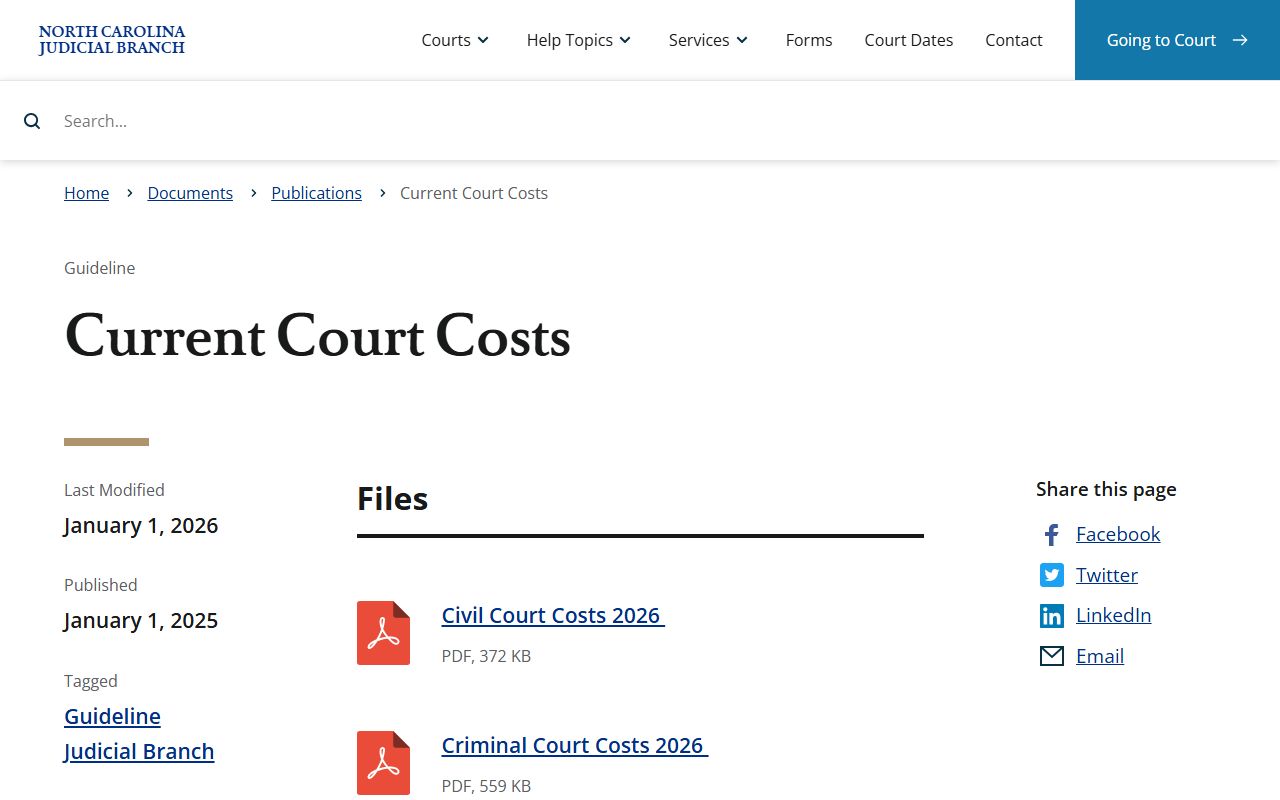
Those publications are the safer reference when a fee changes after a local page or older form has been copied elsewhere.
Alamance County Criminal Record Searches
A criminal background search is not the same task as viewing one case online. The official criminal background check help topic explains that public access terminals and certified searches are the route for criminal record searches through the courts. Portal is useful for public criminal case information, but the research says Portal is not the recommended route for a formal background-check result.
The manifest image below comes from the statewide background-check source: criminal background check.
That distinction matters because a person may need a certified search for official use, while a case lookup may only show public case-level data.
Restricted Alamance County Court Records
Some Alamance County court records are public only in part, or not public at all. Juvenile delinquency files are not ordinary public Portal records. Adoption files are confidential. Mental health commitments contain sensitive medical information. Guardianship files can include private medical and financial details. Sealed records are closed to ordinary public access by law or court order. Expunged records are removed from public court and law-enforcement view under the terms of the expunction order.
North Carolina expunction is statutory. A person does not clear a court record by asking the Sheriff's Office to remove an arrest entry or by filing a general public-records request. The person must identify the case, charge, disposition, conviction status, date, and eligibility statute, then file the correct petition in the county where the case occurred. For an Alamance case, that usually means the Alamance Clerk of Superior Court. The clerk can file-stamp forms but cannot give legal advice.
The broad clerk-access source used for the manifest image is Obtaining court records.
The public access path is broad, but sealed, juvenile, adoption, mental health, protected address, and expunged material can remain outside public view.
Alamance County Court Records In Person
In-person access is the fallback when Portal does not show enough detail, when a certified copy is needed, when a file is older, or when a public terminal search is the right tool. The official records guidance says paper files are accessed by visiting the clerk's office in the county where the case is located. Alamance County divides high-volume court work between the civil courthouse and the criminal courthouse, so the building depends on the record type.
Clerk of Superior Court, Civil Records
Alamance County Historical Courthouse
1 Court Square
Graham, NC 27253
336-570-5200
Monday-Friday, 8:00 AM-5:00 PM
Clerk of Superior Court, Criminal Records
Judge J.B. Allen Jr. Criminal Courthouse
212 W. Elm Street
Graham, NC 27253
336-570-5202
Criminal and traffic matters