
Alamance County Criminal Court Records
Criminal court records in Alamance County begin once a criminal case is opened in North Carolina's state trial courts. The record may start with an arrest-related charge, citation, warrant after execution, information, or indictment, then grow as hearings, motions, pleas, orders, judgments, and sentencing entries are added. The case file is maintained by the Clerk of Superior Court, not by a city court system. North Carolina has one unified statewide court system, so criminal matters from local police departments, the Sheriff's Office, or State Highway Patrol route into District Court or Superior Court.
Criminal matters are conducted at the Judge J.B. Allen Jr. Criminal Courthouse in Graham. District Court handles misdemeanors, infractions, traffic offenses, preliminary criminal processes, and many high-volume settings. Superior Court handles felony cases, indictments, trials, sentencing in felony matters, and appeals from District Court where applicable. The District Attorney for Prosecutorial District 17 reviews and prosecutes state criminal cases, while the Clerk of Superior Court keeps the record that the public searches and requests.
The statewide criminal-case source used for the manifest image is criminal cases.
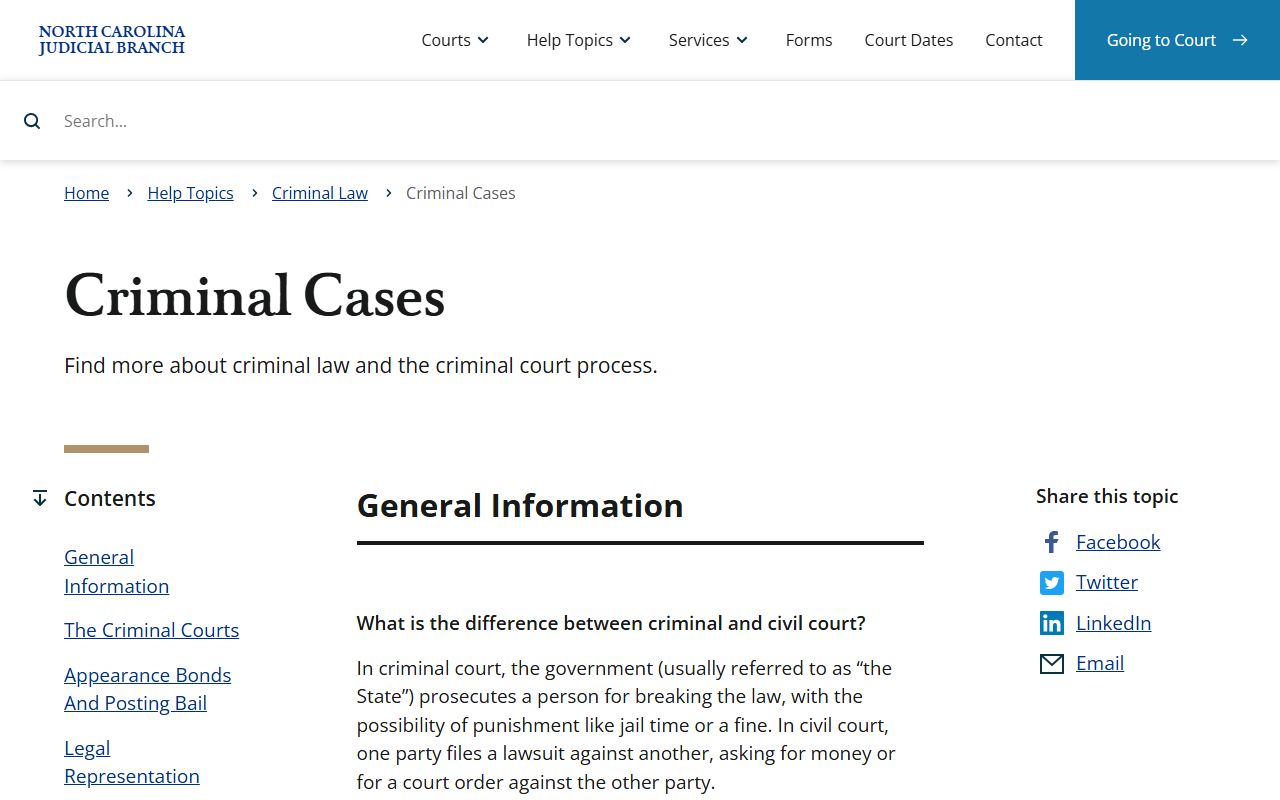
That source supports the case-process focus here: a criminal court record follows the court case, not just the arrest or booking event.
Search Alamance County Criminal Court Records
The main online search route is the NC eCourts Portal. Smart Search can locate public criminal case information by defendant name, case number, citation number, attorney, business name, cross-reference, or nickname. A case number is the cleanest search key. If only a name is known, use the Alamance location filter and add case type, filing date, or status filters when the result list is broad. Search Hearings is the better tool for criminal court dates.
- Open NC eCourts Portal and choose Smart Search for the criminal case file.
- Search by case number, citation number, defendant name, attorney name, or attorney bar number.
- Use Advanced Filtering Options and narrow the location to Alamance when needed.
- Open the public case summary to review charges, events, hearings, disposition, judgment, and public documents if available.
- Use the criminal clerk for certified copies, paper files, older records, public terminal searches, or records not visible online.
Public access terminals in Clerk of Superior Court offices remain a key channel for criminal case information and certified criminal record searches. The official records guidance says terminal searches may use defendant name, case number, and victim or witness name. For a fuller state criminal history or supervision status after sentencing, the N.C. Department of Adult Correction offender search is separate from the county criminal case file.
Alamance County Criminal Case Flow
A criminal court record changes as the case moves. The first public entries may show an accusation, process, first setting, or charge list. Later entries may show bond review, continuances, motions, indictment, plea, trial, verdict, disposition, judgment, sentence, probation, fines, costs, restitution, or failure to appear. A charge can be amended, reduced, dismissed, or replaced before final judgment, so one docket view should not be treated as the final outcome.
Case flow: Charges Filed › Arraignment › Pretrial / Motions › Plea or Trial › Disposition › Sentencing
| Stage | What Happens | What the Record May Show |
|---|---|---|
| Charges Filed | A criminal accusation enters court through citation, warrant process, information, indictment, or related filing. | Charge description, count, offense date, case number, and first court setting. |
| Arraignment / First Settings | The defendant receives formal court processing and scheduling. | Hearing date, courtroom, bond entries, counsel status, or continuance. |
| Pretrial / Motions | Parties file motions, negotiate, seek discovery, or address evidentiary issues. | Motion events, orders, continuances, plea negotiations, and amended charges. |
| Plea or Trial | The case is resolved by plea, trial verdict, dismissal, or other disposition. | Plea, verdict, dismissed counts, acquittal, conviction, or disposition entry. |
| Sentencing | The court enters punishment, costs, probation, restitution, or other conditions. | Judgment, sentence, probation, fines, costs, restitution, and appeal notices. |
Alamance County Criminal Record Fields
The criminal case file can combine identity, charge, hearing, disposition, and financial data. Public Portal results may not show every underlying document, and sealed or restricted information will not be available through an anonymous public search. The court record can show more than a conviction. It can include charges that were dismissed, charges that were amended, pleas that resolved some counts, orders for arrest after a missed date, and sentencing entries after judgment.
| Field | What It Shows |
|---|---|
| Case Number | Enterprise Justice number with year, case type letters, sequence number, and county identifier. |
| Defendant | Name of the person charged, with related party or attorney details when public. |
| Charge Description | Offense title, statute reference, count, class, and offense date when shown. |
| Case Status | Open, pending, disposed, dismissed, appealed, stayed, sealed, or other visible status language. |
| Hearings | Date, time, courtroom, judicial officer, hearing type, and location from Search Hearings. |
| Plea / Verdict | The formal answer or trial result for a charge. |
| Disposition | The outcome of a charge or case, such as dismissed, guilty plea, not guilty, or judgment entered. |
| Sentence | Confinement, probation, costs, fines, restitution, conditions, or other judgment details when public. |
| FTA / Process Entries | Failure to appear, order for arrest, bond, or other court-process entries. |
The court recordkeeping statute source used for the manifest image is G.S. 7A-109.
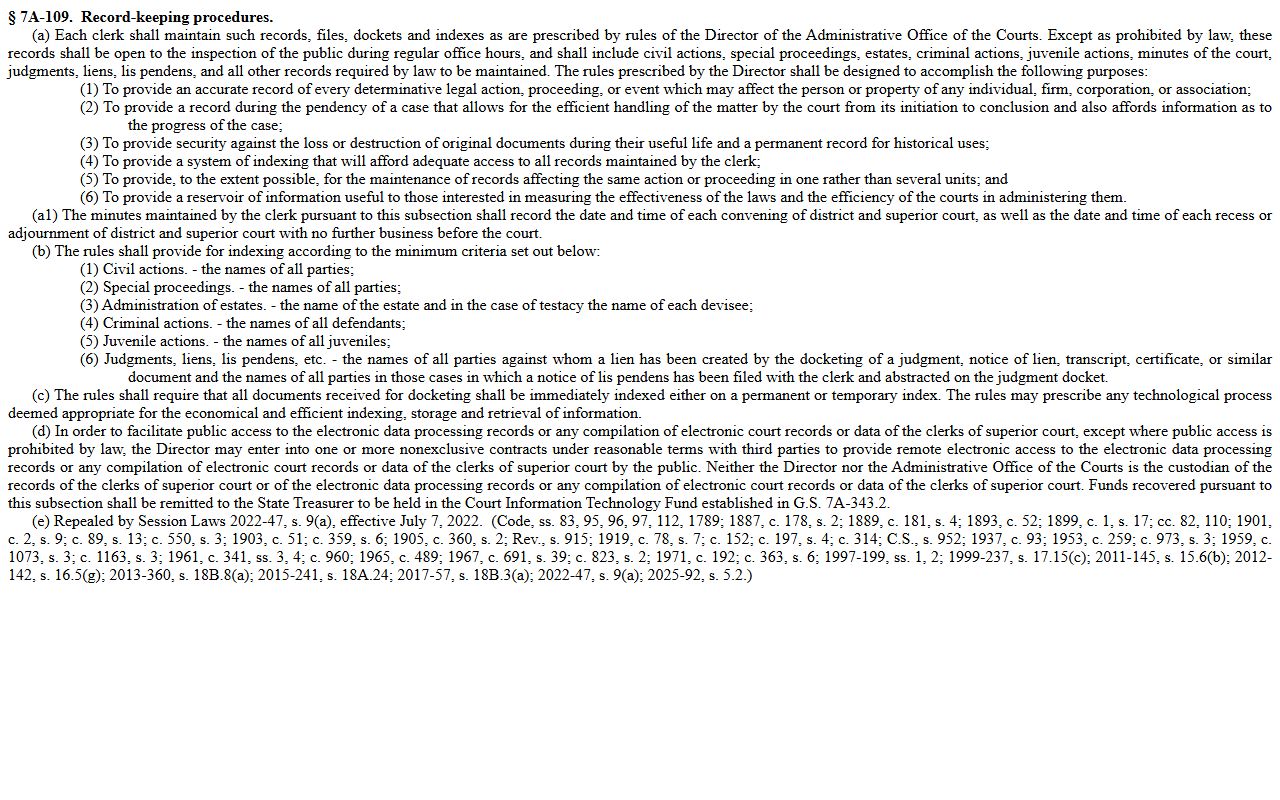
That law is the foundation for clerk-maintained criminal files, dockets, indexes, and regular office-hour public inspection unless access is restricted.
Alamance County Criminal Courts
District Court and Superior Court both produce criminal court records in Alamance County. Misdemeanors and infractions usually begin in District Court. Felonies can begin with first appearances or probable-cause processes, then move to Superior Court after indictment or transfer. Magistrates handle initial criminal processes, warrants or orders, bonds, and preliminary matters under District Court. The District Attorney controls prosecution decisions, including amendments, dismissals, reductions, indictments, and trial presentation.
| Court or Office | Local Role in Criminal Records | Contact Point |
|---|---|---|
| District Court | Misdemeanors, infractions, traffic, first settings, and many preliminary criminal matters. | Judge J.B. Allen Jr. Criminal Courthouse. |
| Superior Court | Felony cases, indictments, trials, felony sentencing, and some appeals from District Court. | Criminal courthouse and Superior Court District 17. |
| Magistrates | Initial appearances, bonds, warrants, orders, and other preliminary processes. | 109 S Maple St, Graham, 336-570-5219. |
| District Attorney | Prosecution, plea negotiations, charge amendments, dismissals, indictments, and trial presentation. | 212 W. Elm St, Graham, 336-570-5210. |
| Clerk of Superior Court | Criminal court record custodian, public terminal access, copies, and paper files. | Criminal clerk, 336-570-5202. |
Charges vs Convictions
A charge is an accusation. A conviction is a finding or admission of guilt. Alamance County criminal court records can show both, but they are not the same. A person may be arrested on one allegation, charged in court with a different set of counts, have a charge reduced, plead to one count, win dismissal of another, or be found not guilty after trial. The case file should be read count by count and date by date.
| Point | Charge | Conviction |
|---|---|---|
| Meaning | A formal accusation filed into the criminal case. | A plea, verdict, or judgment that establishes guilt. |
| Timing | Appears early and may change before final judgment. | Appears after plea, verdict, or judgment. |
| Record effect | May remain visible even if later dismissed unless sealed or expunged. | May carry sentence, costs, probation, restitution, or collateral consequences. |
| Best field to check | Charge list, count, class, offense date, and amendments. | Plea, verdict, disposition, judgment, and sentence. |
For a closer look at the arrest-to-charge path, use the Alamance County arrest records and charges material. For all record types, the broader court records search route explains civil, criminal, probate, traffic, and judgment access.
Alamance County Failure to Appear
Failure to appear is a common criminal record event. The official criminal-case help topic says missing court or arriving late may be treated as Failure to Appear and the judge may issue an order for arrest. The missed-court-date source adds that motor vehicle cases can lead to driver's license revocation and NCDMV fees. A criminal court record may show an FTA entry, order for arrest, new setting, bond change, or later disposition tied to that missed date.
The manifest image source is Missed court date.
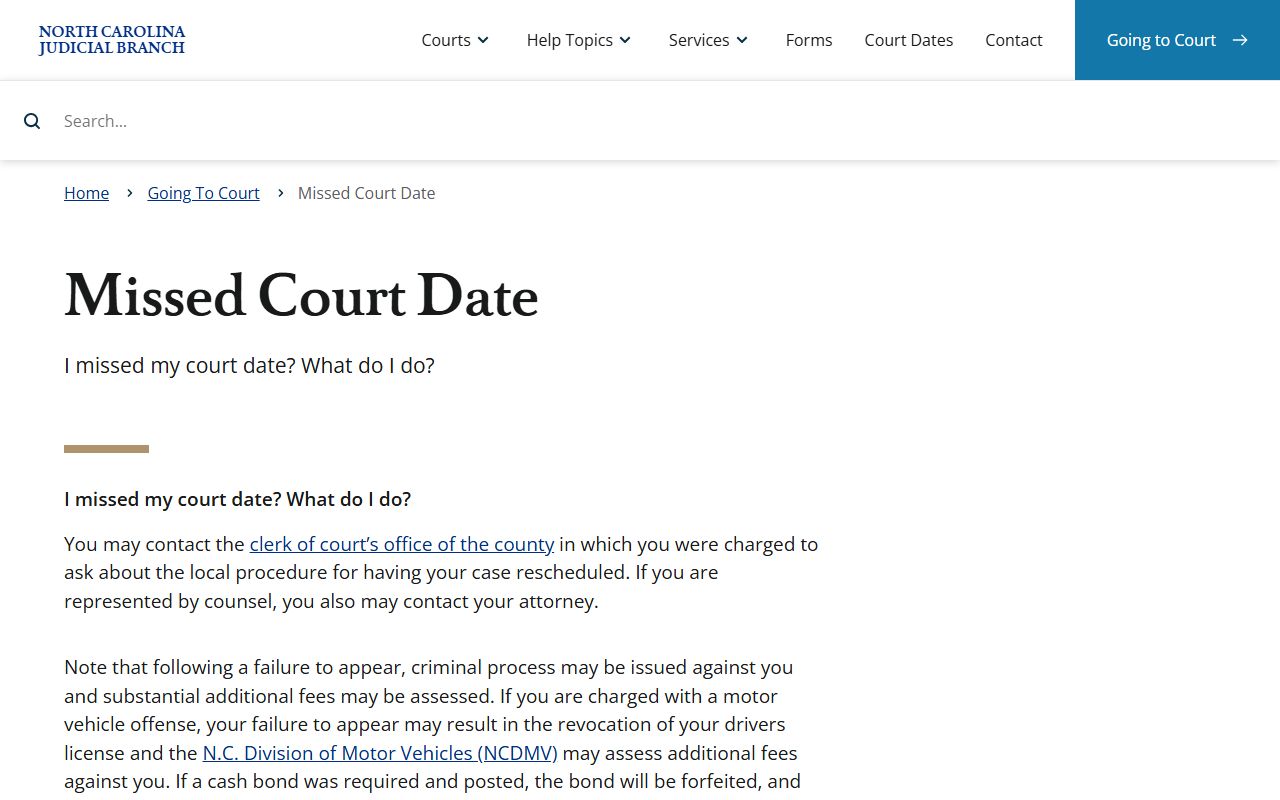
When a missed date appears in the docket, the next practical step is to verify current status with the criminal clerk or counsel.
Alamance County Criminal Records Access
Criminal court records are public unless a law, rule, or court order restricts access. Chapter 15A contains North Carolina criminal procedure and expunction statutes, while G.S. 7A-109 covers clerk recordkeeping and inspection. The Portal gives public online access to publicly available case information. Public terminals, clerk counters, paper files, and certified searches remain important when Portal view is limited or when a certified result is required.
The manifest source for criminal procedure statutes is Chapter 15A.
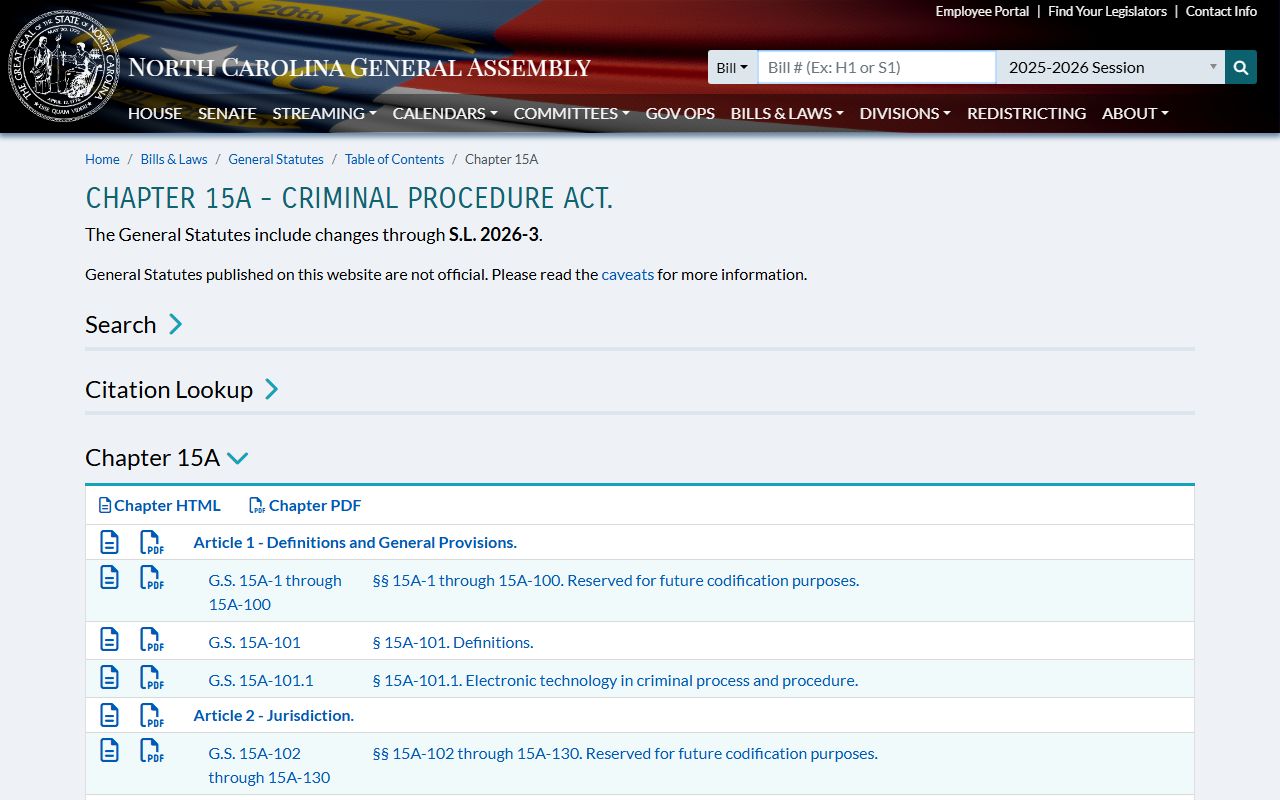
Those statutes are relevant to charge processing, criminal case procedures, expunction eligibility, and post-disposition limits.
Note: A public Portal result is not a certified criminal background check or a complete paper case file.
Sealed vs Expunged Records
Sealing and expunction both limit public access, but they are different. A sealed criminal record is closed to ordinary public inspection by law or court order. An expunction is a statutory process that removes qualifying records from public criminal history under the order's terms. North Carolina eligibility depends on the charge, disposition, conviction type, waiting period, and petition requirements. Juvenile expunction follows separate rules and should not be treated as the same process as adult expunction.
| Point | Sealed Record | Expunged Record |
|---|---|---|
| Public view | Closed to ordinary public access while the seal applies. | Removed from ordinary public court and law-enforcement view under the order. |
| How it happens | By statute or court order. | By petition or statutory process when eligibility is met. |
| Where to start | Review the case and the sealing authority or order. | File in the county where the case occurred, usually through the clerk. |
| Limits | Some agencies or parties may still have lawful access. | May not erase every collateral consequence, such as certain federal consequences. |
The Judicial Branch expunction source used for the manifest image is Expunctions.
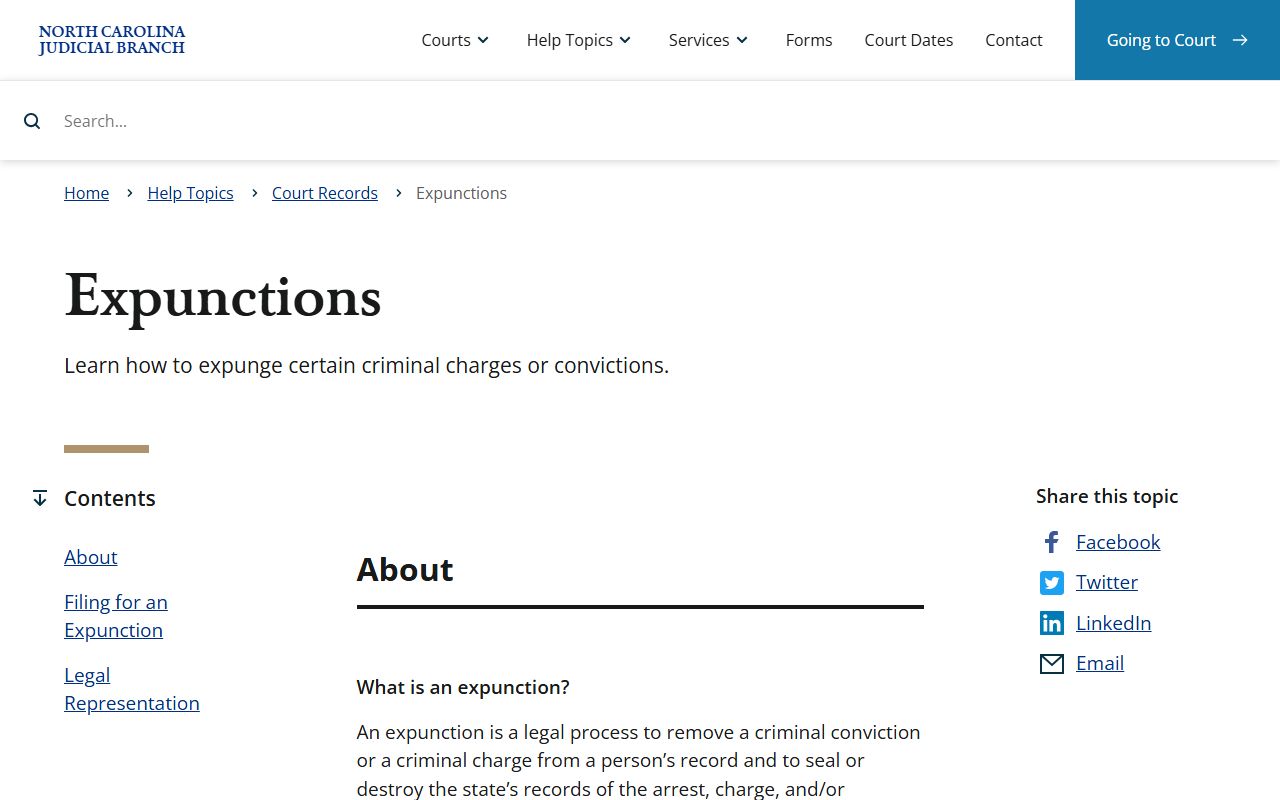
For Alamance County cases, petition-based expunctions normally point back to the Alamance Clerk of Superior Court because the petition is filed where the case occurred.
Federal Criminal Records Are Separate
Federal criminal records are not Alamance County criminal court records. Alamance County is in the federal Middle District of North Carolina, and federal cases are searched through PACER/CM-ECF and the federal court clerk's systems. A federal indictment, federal plea, federal sentence, or federal supervised-release record should not be requested from the Alamance Clerk of Superior Court. Bankruptcy and federal civil records also use federal systems.
The manifest federal source is PACER Middle District CM/ECF listing.
Use federal docket systems only when the case is filed in federal court rather than the North Carolina General Court of Justice.